"Solving an unsolved problem – that's the motivation."
Interview with Michael Schacher, Co-Founder and CEO of Alligator AG, Rotkreuz
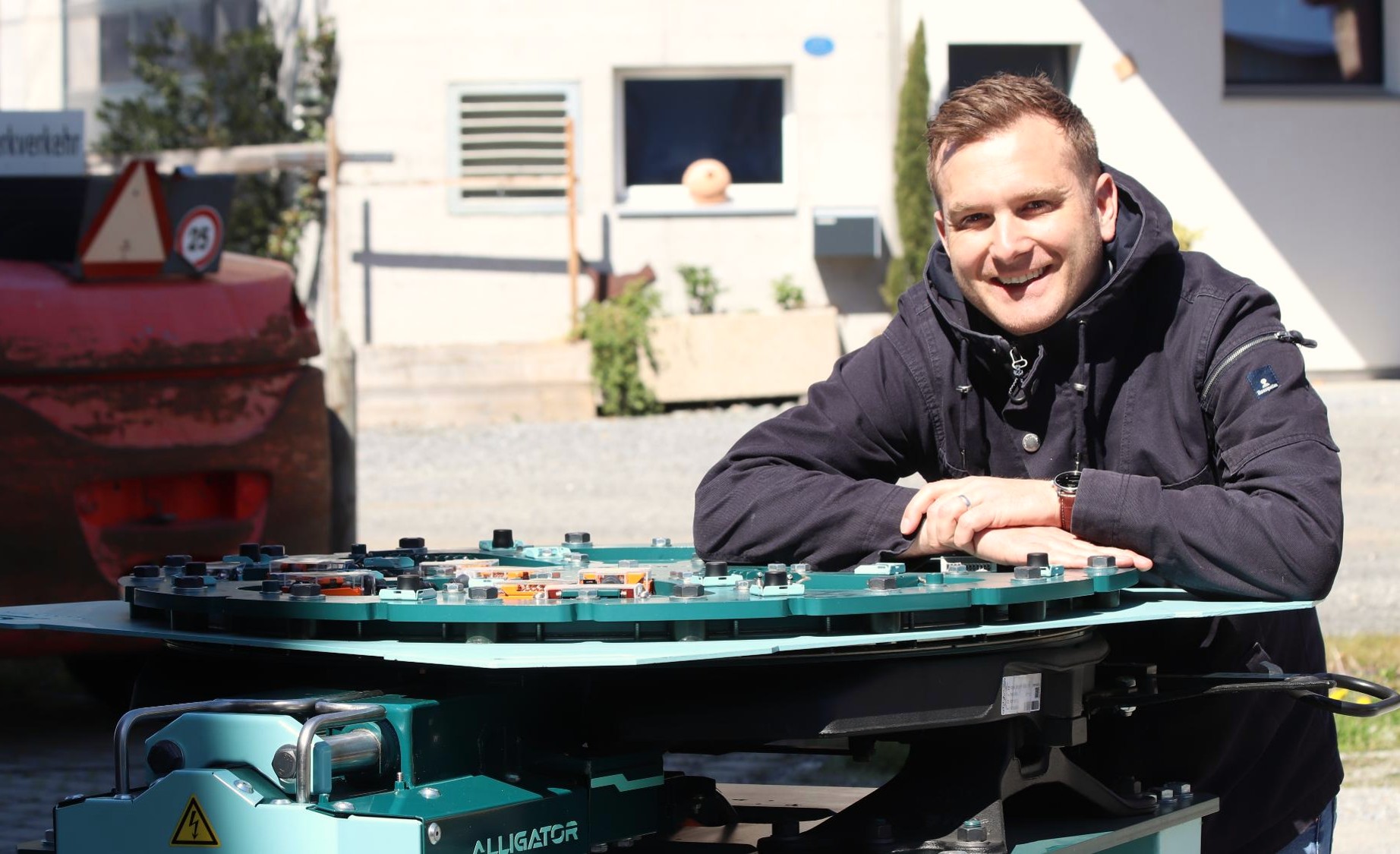
Michael, you originally worked as a project manager in industry before founding Alligator AG. What made you take that leap – and what was the moment you knew: "This is going to be my life's project"?
I was travelling a lot in my previous job. During the pandemic, international travel became almost impossible. I used that time to do something meaningful and started sketching ideas with my brother. Things really took off when we realised we had stumbled onto a genuinely relevant, unsolved problem.
The idea grew out of a family project involving hydraulic lines. How did you find the courage to pivot from a niche hydraulics solution to a pioneering global technology for e-mobility? Was there an "aha moment"?
As someone with a passion for technology, there's a real danger of developing sophisticated solutions that nobody needs. That's exactly the mistake we made with our hydraulic line solution – something we had to admit after talking to industry experts we met at the 2021 transport-CH trade fair in Berne. But those same professionals also explained where the actual problem lay. After a rough market analysis it was quickly clear: the growth trend of e-mobility in heavy transport is unstoppable, and the problem of the high-voltage connection between tractor and trailer is still unsolved.
The planar feedthrough technology is unique worldwide. Can you explain in simple terms how it works – and why nobody came up with this solution before?
Hanging high-voltage lines are not permitted in road traffic – you simply cannot run a cable to connect the power lines between tractor and trailer. So we route the lines through a completely enclosed structure integrated into the trailer floor: the planar feedthrough. This means no moving cables, and we can transfer power between tractor and trailer while driving. That's unique. We recognised the problem early and tackled it radically and without compromise. While everyone else was trying to find a solution for routing cables, we eliminated the moving cable entirely. Today we are the only ones with a working solution.
What was the biggest technical hurdle in development? Were there moments when you thought "We'll never pull this off" – and how did you overcome them?
Yes, regularly – and many of those hurdles still lie ahead of us. But the biggest challenges are not the technical ones. They're about convincing people to change. That requires imagination and courage. You can't simply compare technical data and market volumes 1:1 against an existing product. Many people find that overwhelming, and it makes things extremely difficult when you're developing something that has never existed before.
The technology enables not just energy transfer but also autonomous coupling processes. How far along is Alligator AG – and when might we see the first self-driving e-trucks using your technology?
Soon we'll see trucks on the road where nobody looks out of the cab anymore. On enclosed sites – ports, for example – there are already many projects where trailers manoeuvre autonomously. But in all of these, a person still has to manually plug in the cables for brakes and lighting. With our technology, that's no longer necessary – those lines are coupled automatically. We've built and successfully tested exactly that missing connection. For now, though, we're focused on high voltage – between 400 and 800 volts, genuinely dangerous – because that's where demand is burning and the cost-saving potential is enormous.
You talk about "Energylogistics" – the merging of logistics and energy management. What does that actually look like in practice? Can you describe a concrete scenario?
With diesel it was simple: plug in, 15 minutes, CHF 1.80 per litre. Electrical energy is subject to much greater price swings – prices adjusting every 15 minutes on the spot market. In 2025, the highest price in Switzerland was around CHF 350/MWh and the lowest was minus CHF 290/MWh. On top of that come demand charges, which combined with expensive infrastructure make fast charging very costly. Margins in logistics are tight and energy is one of the biggest operating cost blocks. Whoever recognises the opportunity and draws energy flexibly during the day at low constant power pays a fraction of today's diesel costs compared to competitors who simply replace the diesel pump with a megawatt charger. Our planar feedthrough makes it possible for trailers to be loaded with energy at the depot – independently of the tractor, at low constant charging power. While driving, that energy is transferred into the tractor. This perfect alignment between logistics processes and energy management is what we call "Energylogistics".
The market for electric semi-trucks is set to explode by 2040. Why is your technology ready for scaling right now – and who are your key target customers?
Decarbonisation is a done deal. While the West is still hesitating, questioning, and commissioning studies, emerging markets are skipping that phase and moving straight to implementation – something we see in the enquiries we receive from those regions. Here in Europe, rollout will probably take longer than expected. On one hand, I have experienced in recent years how enormously difficult it is to find capital to close obvious and open technical gaps. On the other hand, grid expansion cannot be ramped up as easily as the production of vehicles and charging stations. But even with maximum pessimism, you still land on a billion-dollar market for high-voltage interfaces. Our current projects involve vehicle converters and OEM research programmes. We bring in the planar feedthrough in the form of a hardware solution. Later, we plan to license the technology to Tier-1 suppliers to serve the broader market. First conversations in that direction are already underway.
In 2024, the cancellation of federal funding almost brought your project to a halt. How did you manage that crisis – and what did you learn?
That was the P&D programme of the Swiss Federal Office of Energy, which targeted exactly the critical gap between research and market. It's incomprehensible to me that they had to shut down that already underfunded link entirely. Funding programmes can make an impossible strategy possible – and bring the whole house of cards crashing down at the same time. Investors recognise that immediately and wait it out. Fortunately, we were recently granted an Innosuisse project by the federal government together with the Lucerne University of Applied Sciences for Electrical Engineering and the Berne University of Applied Sciences for Vehicle Technology, looking into electromagnetic fields, heat development and certification. That gives us momentum again, both technically and for the investor search. There are many programmes at cantonal and federal level, and Horizon Europe is very active in our field. The lesson: always run multiple applications in parallel, never put all your eggs in one basket. Five applications each with a 20% chance gives 100% 😉
The logistics industry has a reputation for being conservative. How do you win over hauliers and investors who are still sceptical?
When it comes to technology, I find logistics entrepreneurs anything but conservative. Many of these owners have dedicated most of their lives to their business. For them, trucks are more than machines – they understand the technology inside out. It never takes more than a few minutes for them to grasp exactly what problem we're solving and see its relevance. With investors and innovation experts, it's far more difficult.
Are you currently looking for investors? What can you concretely offer potential partners today – and what is your USP against competitors?
We recently secured the financing for the next steps. But of course: as an innovative company without an existing business behind us, we are always looking for investors. Many investors expect a detailed milestone plan. With a project like ours – with many system boundaries to other companies, unpredictable funding applications, and all the politics surrounding decarbonisation – that is only partially possible. We have a crystal-clear long-term vision, but the intermediate steps are sometimes also luck and guided coincidence. So far we have always found partners who don't care about short-term milestones. They believe in the big goal and a team that has the skills and fights for it with full energy. We are today the only ones with a working solution to this problem – patent-protected, of course. And we are looking for partners who are ready to make this achievement a reality together with us.
You've said "it's not about the brand, it's about the technology." Why is that so important to you – and how do you ensure the technology stays front and centre?
Marketing and branding matter when you have to compete against rivals. Think of the GDR – many products had only one manufacturer, so brands were irrelevant. As long as we're the only ones with a solution, it's simply not smart to spend resources in that direction. Once we have competitors one day, we can hopefully afford an agency that enjoys doing it.
If your technology succeeds: what might freight transport look like in 10 years? Will we still see diesel trucks?
Yes, absolutely. Even in 20 years. The EU aims to cut emissions by 90% by 2040 – but that applies to new registrations, not the existing fleet, where diesel will remain. But our technology would accelerate the transition. Integrating the trailer into the high-voltage network increases the range of applications and energy efficiency – for example through recuperation of the trailer braking force, which alone can reduce a vehicle's energy consumption by up to 16%. Add to that greater range, better weight distribution, and major savings on energy purchasing. These aren't nice-to-haves – these are compelling arguments for switching to electric. We have spent a lot of time crunching the numbers over the past years, and the Lucerne University of Applied Sciences also carried out a feasibility study on this topic at Dreier AG. For me the case is clear: anyone who wants to remain competitive in electrified heavy transport long-term cannot afford to leave the trailer out of the network.
The Swiss Climate Foundation and the Lucerne University of Applied Sciences support you. How important are such partnerships – and what advice would you give other founders pursuing similar innovations?
The Swiss Climate Foundation was one of the first to believe in our vision. Later came E-Force and the Albert Köchlin Foundation. Recently, Kinell GmbH from Kaufbeuren in the Allgäu, with whom we work together on this topic, also received funding from the German government for this area. The Lucerne University of Applied Sciences for Electrical Engineering has supported us for some time when things get more complex on the electrical engineering side. They immediately understood the problem we are working on and got involved to solve it together. We are thrilled that we can now continue this collaboration in a federally co-financed Innosuisse project, which also involves the Berne University of Applied Sciences. The door that reopened in 2025 for Swiss companies at Horizon Europe also opens up great networks in our field that help transfer innovations into industry. That makes a lot of sense – logistics and climate change are topics that go beyond national borders. All of this support is wonderful and gives you the strength to keep fighting and pushing through. Advice to other founders is not really my thing – there are always a thousand right ways. But here is what I can share: in Switzerland there is a lot of capital, but little of it for risky adventures. For this reason, new technologies can hardly be financed without funding programmes. So find the connection to an academic partner as early as possible – only that way do you have a chance of accessing funding. That's how the system works in Switzerland.
You've said you "work almost non-stop and sleep badly". How do you manage to stay motivated despite the enormous pressure – and what gives you the energy to keep going?
Of course you do it in the hope that the pressure will ease at some point. Especially in the early phase, when you are still very weak, most people treat you like dirt. Especially at large companies – they laugh because you don't yet have 500 LinkedIn contacts or print your own business cards. Small things. The technology itself, and the potential future threat it poses to their own business model, gets completely blanked out. In 99% of cases that's fine. But that remaining 1% has already brought down entire corporations. But that's not the motivation. The motivation is simply this: solving an unsolved problem. If someone else had done it, I'd never have thought of starting a company and could now be living a life with work-life balance. That's not possible now – the little free time that remains belongs to my kids.
If you could give one piece of advice to a young engineer or founder today: what's the most important lesson you've learned?
Don't overthink it – and even more importantly: don't let yourself be over-advised. Just start, and do what you do out of conviction. Then it either works out or it doesn't – either way, you'll be wiser afterwards.